
Master-Plan Fundamentals
| Parameter | Detail |
|---|---|
| Total land area | 9.73 acres (confirmed) |
| Saleable potential | ~0.89 million sq ft (confirmed) |
| Estimated GDV | ~₹800 crore (confirmed) |
| Anticipated built form | Mid-to-high-rise towers on a landscaped podium |
| Anticipated open space | Majority of ground plane held as landscaped / amenity open space |
| Height regime | Governed by AAI (airport approach zone) clearances |
| Tower count | Under design — not yet published |
| Unit density | Under design — not yet published |
| Anticipated configurations | 2 & 3 BHK; possible 3.5 BHK |
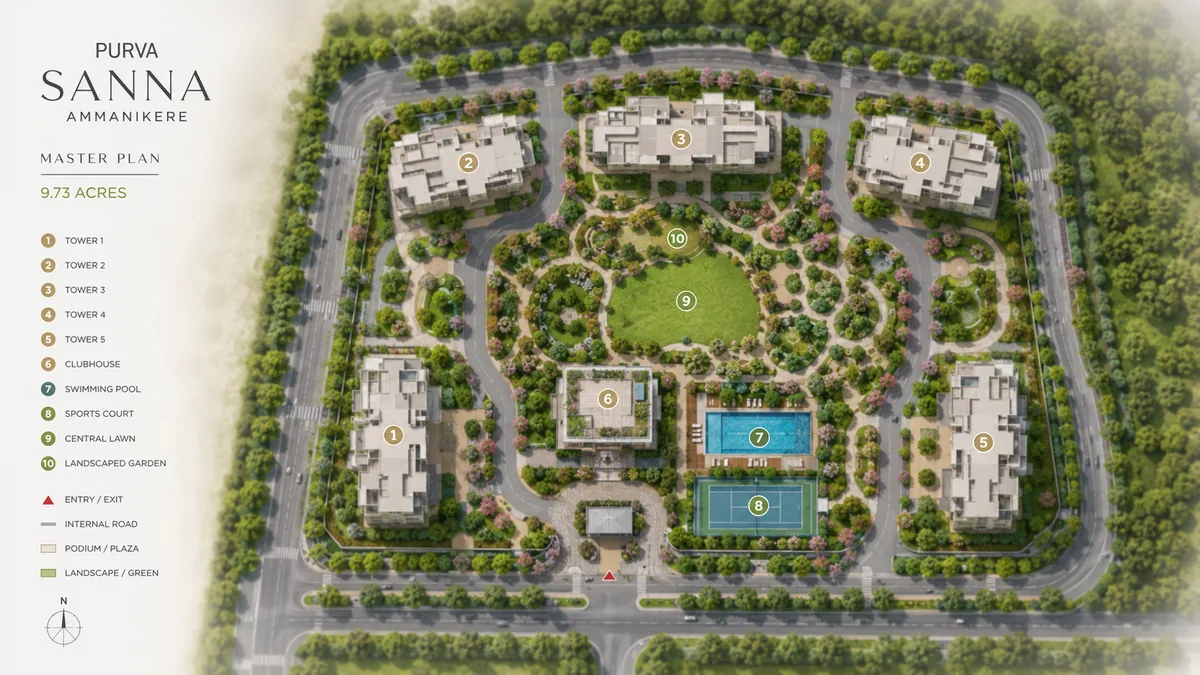
The 9.73-acre canvas is a meaningful advantage. It is large enough to carry a full township-grade amenity base, a generous central green, and inter-tower spacing that protects daylight, cross-ventilation, and privacy — while remaining compact enough to feel like a single cohesive community rather than a sprawling multi-phase estate. A parcel of this scale gives Sanna Amanikere room to hold the majority of its ground plane as open, landscaped space around the towers. Puravankara Sarjapur Road is useful for the site-planning lens because buyers should read open space, movement, parking, and amenity placement as everyday-use details, not brochure decoration.
Site Layout Philosophy
Puravankara's flagship apartment communities follow a consistent layout logic, and Purva Sanna Amanikere is anticipated to express it. The organising principles are:
- Towers on a podium, greens at grade. Concentrating built form into a set of taller towers frees the ground plane for landscape, water features, and amenities. This "tall-and-green" approach maximises usable open space per resident compared with a low-rise, spread-out block layout.
- A central green spine. A landscaped central axis typically threads the community — a walkable green corridor connecting the arrival court, the clubhouse precinct, the pool deck, and the play and sports zones, giving every tower a line of sight to open space.
- Amenity clustering. The clubhouse and the primary amenity deck are usually located at the heart of the plan or along the central spine, so the community's social infrastructure is equidistant from the towers rather than favouring one edge.
- Peripheral buffering and security. A landscaped perimeter, a single controlled arrival point (or a small number of controlled gates), and a clear separation of vehicular and pedestrian movement are standard, giving the community a secure, calm internal environment.
- Podium and basement parking. Car parking is typically resolved in podium and/or basement levels, keeping surface parking minimal and preserving the ground plane for greenery.
Anticipated Built Form and Height
The Devanahalli airport belt sits inside the Kempegowda International Airport approach zone, where building heights are governed by Airports Authority of India (AAI) clearances. In practice, this means development on the belt favours a mid-to-high-rise format within a regulated envelope rather than a single super-tall tower. For a 9.73-acre parcel with ~0.89 million sq ft of saleable area, the anticipated built form is a set of several towers — the exact count and height under design — arranged to keep density comfortable and inter-tower spacing generous.
This height regime is not a constraint on quality; it shapes a format that is well suited to family living — human-scaled towers, abundant ground-level greenery, and daylight-optimised layouts. The exact number of towers, floors per tower, and units per floor will be confirmed at launch, alongside the RERA filing. No tower or unit count should be quoted as fact until Puravankara publishes it.
Anticipated Amenity Zoning
The master plan is anticipated to organise amenities into distinct zones, a standard Puravankara approach:
| Zone | Anticipated content |
|---|---|
| Arrival & clubhouse precinct | Grand entrance court, clubhouse, gymnasium, indoor games, multipurpose hall, co-working lounge |
| Water & wellness zone | Swimming pool, kids' pool, pool deck, spa / sauna, yoga and meditation deck |
| Active sports zone | Tennis, badminton, and basketball courts, cricket practice net, outdoor gym |
| Central green spine | Landscaped park, walking and jogging tracks, cycling track, seating courts |
| Family & community zone | Children's play areas, senior citizens' plaza, amphitheatre, pet park, community lawn |
| Utility & sustainability | STP, rainwater harvesting, organic waste converter, solar-assisted lighting, EV charging, power backup |
This zoning gives the community a legible internal geography: a social heart at the clubhouse, a wellness quarter around the pool, an active-sports edge, and a green spine binding it together. The amenities page details the full anticipated inventory.
Open Space and Landscape Strategy
Open space is central to the Puravankara flagship promise, and a 9.73-acre parcel supports a generous allocation. The anticipated strategy holds the majority of the ground plane as landscaped and amenity open space, with the central green spine as the organising landscape gesture. Expected landscape elements include a central park and lawn, tree-lined walkways, water features at the arrival and pool zones, reflexology and sensory pathways, and buffer planting along the perimeter. The goal — consistent with the developer's delivered communities — is a green, low-density-feeling environment despite an efficient tower footprint, so that residents experience the community as a garden with homes in it, rather than as blocks with landscaping around them.
Planning Snapshot
Anticipated Phasing
At 9.73 acres, Purva Sanna Amanikere is sized as a community that can be delivered in a single phase or a small number of phases, depending on the eventual tower configuration and Puravankara's launch strategy. This is a more contained parcel than the developer's large multi-phase townships (such as the 24.55-acre Purva Northern Lights), which typically favours a single- or two-phase delivery. The phasing structure will be confirmed at launch. For a pre-launch buyer, the practical read is that a compact, single-community parcel usually means a shorter overall delivery horizon and a more cohesive final product than a large, multi-year township — a point in the community's favour.
Connectivity Within the Master Plan
The site plan is anticipated to resolve internal circulation cleanly: a controlled arrival court off the approach road, a clear vehicular loop feeding podium and basement parking, and a pedestrian-priority internal network of walkways connecting the towers to the clubhouse, the pool, the sports zones, and the greens without crossing vehicular paths. Visitor parking, drop-off, and service access are typically separated from resident circulation. The result — consistent with Puravankara's delivered communities — is a community where day-to-day movement is calm, safe, and green.
Density and Livability
A master plan's most important quiet decision is density — how many homes are placed on the parcel, and how they are spaced. At 9.73 acres with ~0.89 million sq ft of saleable area, Purva Sanna Amanikere is anticipated to sit at a comfortable density for a premium airport-corridor community: substantial enough to carry a full amenity base and support the economics of a ₹800-crore GDV, but not so dense that the community loses the open-plane, garden-led character that defines the Puravankara flagship promise. The tall-and-green layout logic is the mechanism that reconciles those two goals — concentrating built form vertically so the ground stays open. Generous inter-tower spacing is what protects the day-to-day livability metrics buyers feel but rarely name: daylight into each apartment, cross-ventilation, acoustic privacy between towers, and clear sightlines to greenery rather than to a neighbouring wall. The final density will be confirmed with the published tower count and unit schedule at launch; the anticipated framework prioritises livability over maximal yield, consistent with the developer's flagship positioning.
Vehicular and Pedestrian Separation
A well-resolved master plan keeps people and cars apart. Purva Sanna Amanikere is anticipated to follow the standard Puravankara approach: a controlled vehicular arrival court and drop-off at the entrance, a peripheral or podium-level vehicular loop feeding the parking levels, and a pedestrian-priority internal realm — the green spine and the walkways connecting the towers to the clubhouse, the pool, the sports courts, and the play zones — that residents can traverse without crossing a road. Service and visitor movement are typically routed separately from resident circulation, and emergency-vehicle access is planned to reach every tower. The practical result is a calm, safe, walkable internal environment: children can move between the play area and the clubhouse without a road crossing, and the daily experience of the community is of a landscaped pedestrian realm rather than a car-dominated one.
What the Master Plan Signals to a Buyer
For a prospective buyer, the anticipated master plan signals three things. First, scale with cohesion: 9.73 acres is large enough for a full amenity base and generous greens, but compact enough to remain a single, legible community. Second, open-space priority: the tall-and-green layout logic maximises usable landscape per resident, which is both a lifestyle benefit today and a resale strength tomorrow. Third, delivery discipline: a contained parcel, an outright-owned title, and a listed developer with a five-decade delivery record together lower the execution risk that a pre-launch buyer must weigh. The final, published master plan will confirm the tower count, unit density, and detailed layout at launch; the framework above is the anticipated shape of the community, grounded in the developer's flagship product and the corridor's directly comparable projects.
Master-Plan Summary
| Element | Anticipated position |
|---|---|
| Land area | 9.73 acres |
| Saleable area | ~0.89 million sq ft |
| Built form | Mid-to-high-rise towers on a landscaped podium |
| Open space | Majority of ground plane as landscape / amenity |
| Amenity heart | Central clubhouse precinct on the green spine |
| Parking | Podium / basement, minimal surface parking |
| Height regime | AAI airport-approach-zone clearances |
| Phasing | Single or small-number phases (anticipated) |
| Configurations | 2 & 3 BHK; possible 3.5 BHK |
The master plan for Purva Sanna Amanikere will be published in full at the formal launch. Register early interest through the contact form to receive the detailed site plan, tower layout, and configuration sheet as soon as they are released.
Planning visuals and the anticipated framework are indicative references sourced from Puravankara's flagship product and comparable corridor projects. Verify the latest approved and stamped master plan documents before booking.
Need a guided walkthrough of the anticipated master plan with amenity zoning, circulation, and built-form logic explained in plain language?
Due-diligence references
Read together with gallery and location on this website. Compare landscape distribution, amenity placement, tower spacing, and how clearly the anticipated plan supports everyday movement inside the community.
Purva Sanna Amanikere Master Plan FAQs
How large is the Purva Sanna Amanikere master plan?
The development is planned across a confirmed 9.73-acre parcel with approximately 0.89 million sq ft of saleable potential and an estimated ~₹800 crore GDV. The canvas is large enough to carry a full township-grade amenity base, a generous central green, and inter-tower spacing that protects daylight, cross-ventilation, and privacy, while remaining compact enough to feel like a single cohesive community.
What built form is anticipated in the Purva Sanna Amanikere master plan?
A set of mid-to-high-rise towers on a landscaped podium, with the majority of the ground plane held as landscaped and amenity open space. The Devanahalli airport belt sits inside the Kempegowda International Airport approach zone, where building heights are governed by Airports Authority of India (AAI) clearances, so development favours a mid-to-high-rise format within a regulated envelope rather than a single super-tall tower. The exact tower count and heights are under design and not yet published.
How is the site organised in the Purva Sanna Amanikere master plan?
The anticipated layout follows Puravankara's flagship logic: towers on a podium with greens at grade, a landscaped central green spine connecting the arrival court, clubhouse, pool deck and play zones, amenity clustering at the heart of the plan, a landscaped perimeter with controlled access, and podium or basement parking to keep surface parking minimal and the ground plane green.
How does circulation work in the Purva Sanna Amanikere master plan?
A controlled arrival court off the approach road, a clear vehicular loop feeding podium and basement parking, and a pedestrian-priority internal network of walkways connecting the towers to the clubhouse, the pool, the sports zones, and the greens without crossing vehicular paths. Visitor parking, drop-off, and service access are typically separated from resident circulation, so day-to-day movement is calm, safe, and green.
How will Purva Sanna Amanikere be phased?
At 9.73 acres, the community is sized to be delivered in a single phase or a small number of phases, depending on the eventual tower configuration and Puravankara's launch strategy. This is a more contained parcel than the developer's large multi-phase townships, which typically favours a single- or two-phase delivery and a shorter overall delivery horizon. The phasing structure will be confirmed at launch.
Is the Purva Sanna Amanikere master plan final?
No. The project is at the pre-launch stage, so the specific tower count, unit density, and detailed site plan are under design and have not been published. The framework on this page is the anticipated shape of the community, grounded in Puravankara's flagship product and the corridor's directly comparable projects. The final, published master plan will confirm the tower count, unit density, and detailed layout at the formal launch, alongside the RERA filing, and no tower or unit count should be quoted as fact until then.